COP30 Put Water at the Center of Climate Discussions; Water and Sanitation Institute - IAS Participated in Panels at the Event
16 Dec 2025
For the first time, IAS sent representatives to the climate conference, which saw broad participation from civil society and social movements.
16 Dec 2025
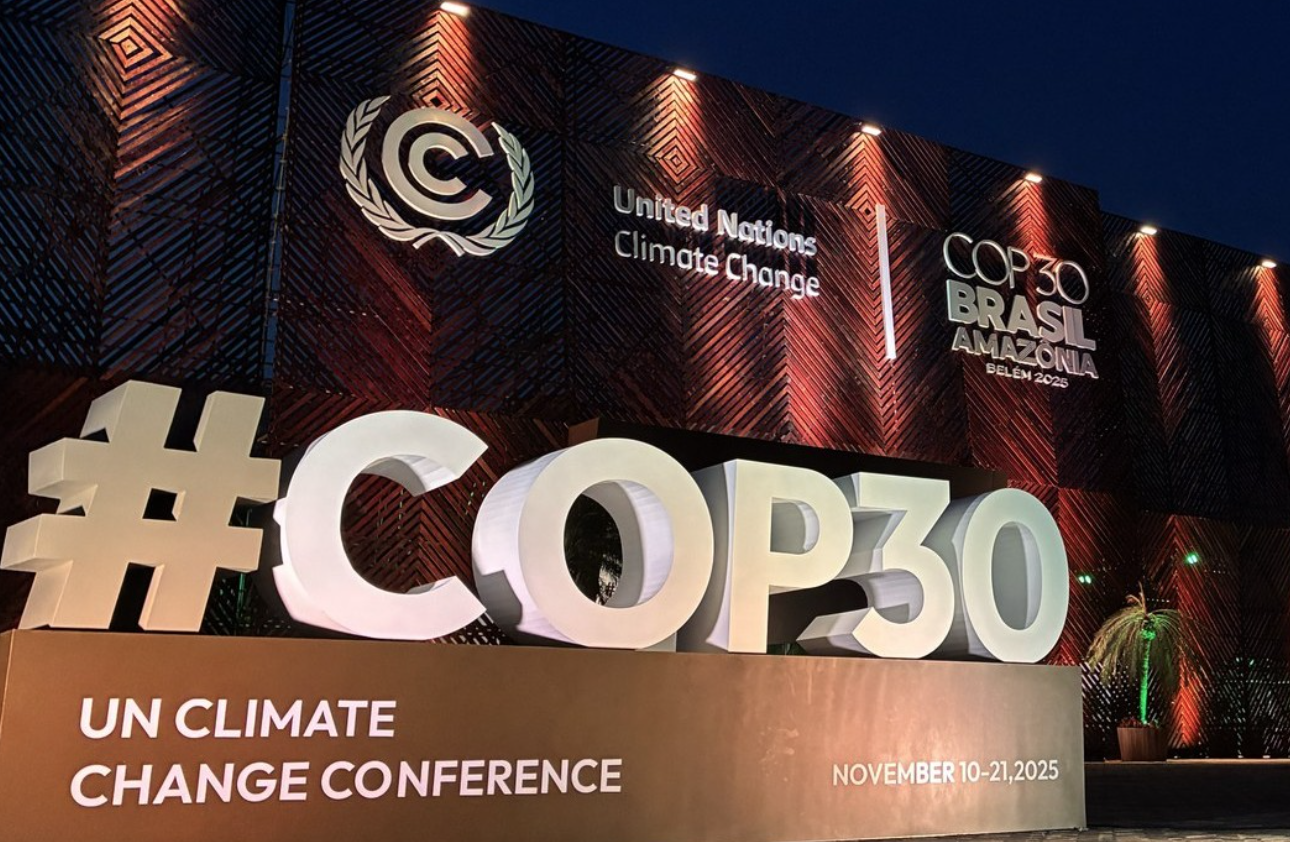
The importance and symbolism of COP30, hosted for the first time in Brazil, in an Amazonian city, were enormous. The event held in Belém was also notable for its total of 56,000 registered participants, the second largest COP in history according to this metric.
Although much of the news coverage focused on logistical and organizational issues, and despite the absence of a decision on fossil fuels in the conference’s final text, progress was made on several other fronts. It was also the first COP held in a democratic country since 2021, with broad participation from civil society and social movements.
For the first time, IAS took part in the conference, sending two representatives: Paula Pollini, coordinator for articulation and advocacy; and Eduardo Caetano, coordinator for knowledge and dissemination. The Institute’s experts participated in panels where different perspectives on the convergence between water, sanitation, and climate were discussed.
Water was a significant theme at the event, starting with the presence of the Water for Climate Pavilion inside the Blue Zone, the conference area where official negotiations, the Leaders Summit, and national pavilions took place. In that space, more than ninety organizations discussed topics such as water security and climate adaptation.
Water also appeared as part of one of the six thematic axes of COP30’s Action Agenda, which defines practical priorities and lines of global collaboration to accelerate implementation of the Paris Agreement. Under the axis “Building resilience in cities, infrastructure and water,” “water management” is listed as one of the stated objectives.
One of COP30’s most significant outcomes was the formal adoption of a set of indicators under the Global Goal on Adaptation (GGA). The decision confirms that the Parties agreed on an annex with fifty-nine indicators covering the main domains where climate impacts are felt, including water supply and sanitation.
In this way, water supply and the resilience of water systems were incorporated into the global adaptation framework. This acknowledges that climate impacts are felt primarily through water—whether through scarcity, flooding, declining quality, or pressure on infrastructure.
Where IAS Was Present
IAS’s first participation at COP30 was in the panel “From Madrid to Belém: Advancing Water Resilience through the 2025 High-Level Leaders Compact”, organized by Sanitation and Water for All (SWA), Alliance for Global Water Adaptation (AGWA), and the Government of Spain, on November 12, in the Blue Zone.
Preceded by a keynote address by Michelle Bachelet, former President of Chile and current member of SWA’s Leadership Council, the meeting aimed to raise the Compact’s visibility as a framework for advancing water resilience and to secure government support so that the Compact is incorporated into national climate planning.
The panel included Giuseppe Serra Seca Vieira, National Secretary for Water Security (Ministry of Integration and Regional Development); Ana Paula Fioreze, superintendent for water and socioeconomic studies at Agência Nacional de Águas e Saneamento Básico (ANA; National Water and Basic Sanitation Agency); Kamala Abishova (representative of the Ministry of Foreign Affairs of Azerbaijan); Sonja Koepel, co-chair of the UN Expert Group on Water and Climate Change and Secretary of the UNECE Water Convention; and Paula Pollini, from IAS.
On November 14, Paula Pollini took part in the panel “From Targets and Indicators to Action on the Ground: Implementing the UAE Global Framework for Transformative Climate Resilient Water and Sanitation”, organized by SWA and WaterAid. This session focused on operationalizing the UAE Framework for Global Climate Resilience, agreed at COP28, with strong emphasis on implementation challenges, guidance, and financing.
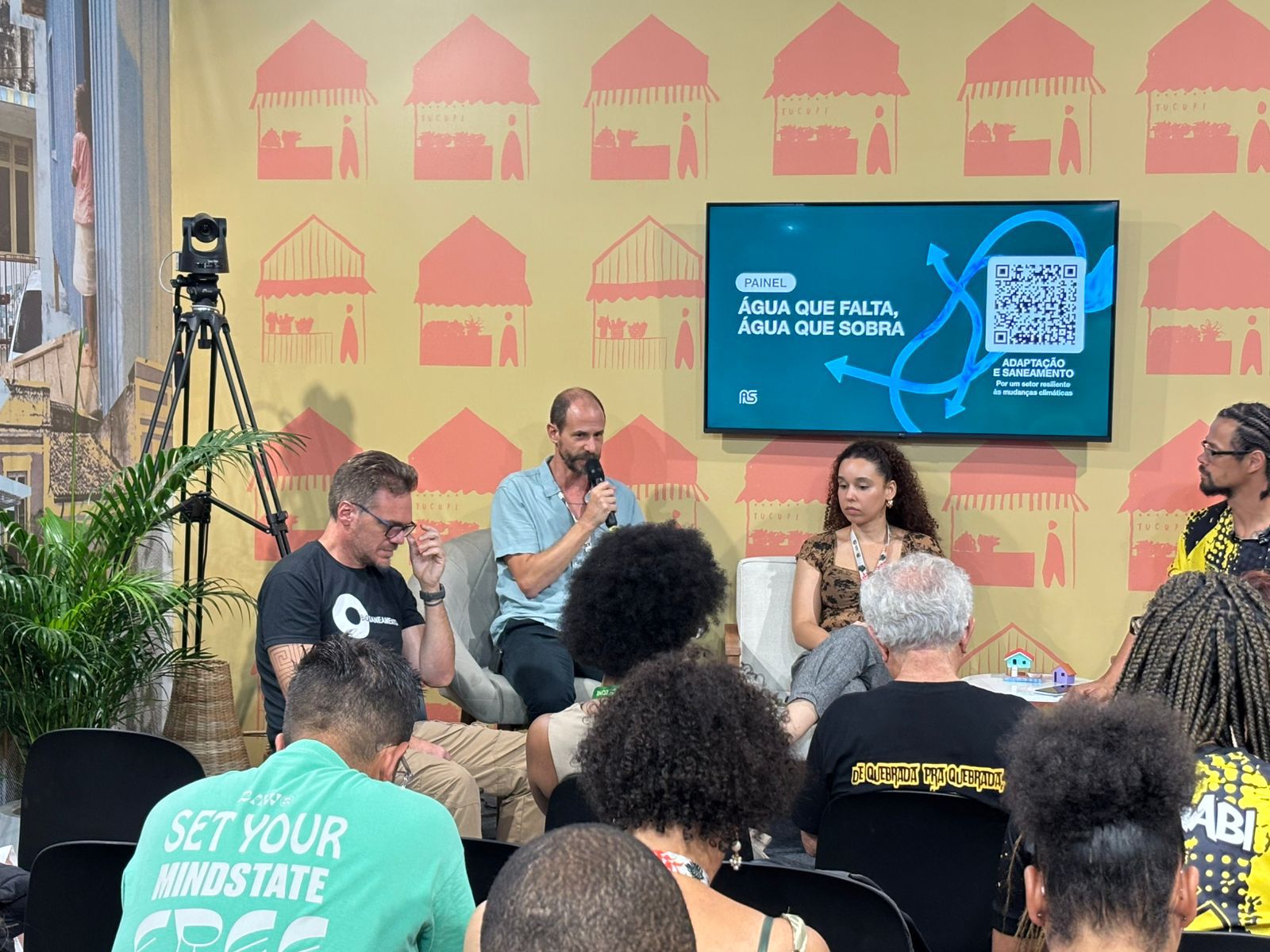
On November 18, it was Eduardo Caetano’s turn to lead the panel “Water That Overflows, Water That Runs Short – Challenges and Solutions for Resilient Sanitation” (photo above), organized by IAS itself at the Council of Architecture and Urbanism - CAU venue. Joining the conversation were Luiz Fazio, president of Biosaneamento; Everton da Silva Oliveira, from Ciclolog; and Malu Barbosa, from Ressuscita São Gonçalo.
On World Toilet Day, November 19, the panel “Sanitation for Those Who Don’t Have It: Brazil Without Toilets” took place—a partnership between IAS, National Health Foundation – Funasa and Brazilian Association of State Sanitation Companies – Aesbe. All acronyms refer to the institutions’ names in Portuguese. Eduardo Caetano represented the Institute in the discussion with Alexandre Motta, from Funasa, and Sergio Gonçalves, executive director of Aesbe. The panel addressed the urgency of public policies focused on universalizing sanitation and the impacts of its absence on human dignity and public health.
Finally, on November 20, the session “Sanitation Without Exclusion: Challenges and Opportunities to Reduce Deficits” took place, organized by National Confederation of Municipalities - CNM. In addition to Eduardo Caetano, from IAS, the panel included Alexandre Motta, from Funasa; Marco Lobo, from the Brazilian Institute of Geography and Statistics State Superintendency in Pará; Sergio Gonçalves, executive director of Aesbe; João de Deus and Claudia Lins, from CNM; and Daniel Sombra, a researcher at Federal University of Pará (UFPA).
The discussion focused on service provision for vulnerable populations, especially in rural areas and peripheral regions. A rainwater harvesting project was presented that ensures water security for traditional communities on Combu Island, as part of the “Water for All” initiative carried out by State Secretariat for the Environment, Climate and Sustainability - Semas and Institute for Forest Development and Biodiversity of Pará - Ideflor-Bio.
Read more
Share
Topics
IAS Newsletter
Subscribe to our newsletter to receive the latest news on sanitation and updates from IAS.
Initiatives
Discover IAS initiatives that aim
to inspire change in the sanitation sector

Municipalities and Sanitation
Access the latest data on sanitation in Brazilian municipalities.

World Toilet Day
Every year, we promote actions to raise awareness about the importance of access to proper toilets and hygiene.

Water and Sanitation Forum
This is a permanent space for dialogue and idea exchange among various social actors connected to the sanitation sector and its cross-cutting themes.